
Uncategorized
Tree Peonies
Oct
Just about all of the tree peonies in my garden were gifts. Some 36 years ago, Criss and I had no sooner moved to Burnside Farm in Ascot, which became Lambley Nursery, when a local farmer brought a large, healthy plant of Peaonia ‘Ettienne de France’ as a welcome-to-the-district gift. Reg Kinnersley had worked on the property when he was a boy and was given a plant of this peony by Mrs Lester in the 1920s. Reg planted the peony in the garden of his family farm where it flourished for the next seven decades. He told me that he wanted to bring a plant back to Burnside.
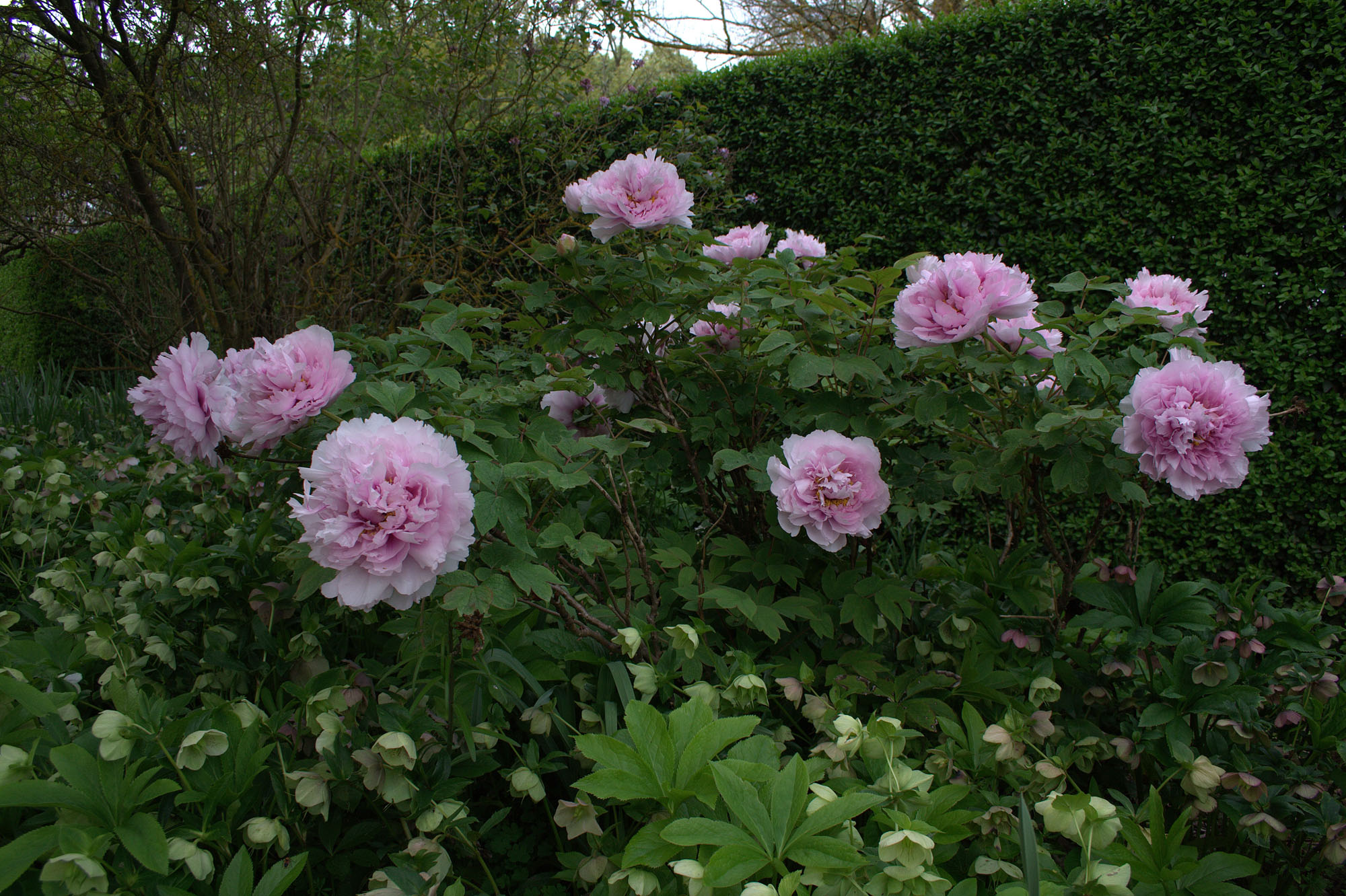
Although known in Australia as ‘Ettienne de France’ this peony has nothing to do with France but was brought into Australia by Chinese gold diggers in the middle of the 19th century. Fully double and soft pink it is a sumptuous flower and very like those figured on Chinese ceramics. Tree peonies, Paeonia x suffruticosa, have been cultivated in China since at least the Tang dynasty (618-907 AD) when they were grown in the palace gardens. It is known as the flower of wealth and honour and was often given as a token of love. Be that as it may it just as likely that the first tree peonies, brought into Australia were carried by Chinese miners into the gold fields of the central highlands of Victoria, were grown as much for medicinal purposes as for the beauty of their flowers. The bark on the roots of tree peonies is considered to be the most potent of all traditional Chinese medicines having the perfect balance of Yin and Yang.
“It can dilate coronary arteries, reduce coronary resistance, coronary, cerebral and renal blood flow, improve microcirculation, lower blood pressure, enhance immunity and so on”
– Chinese Herbs Healing
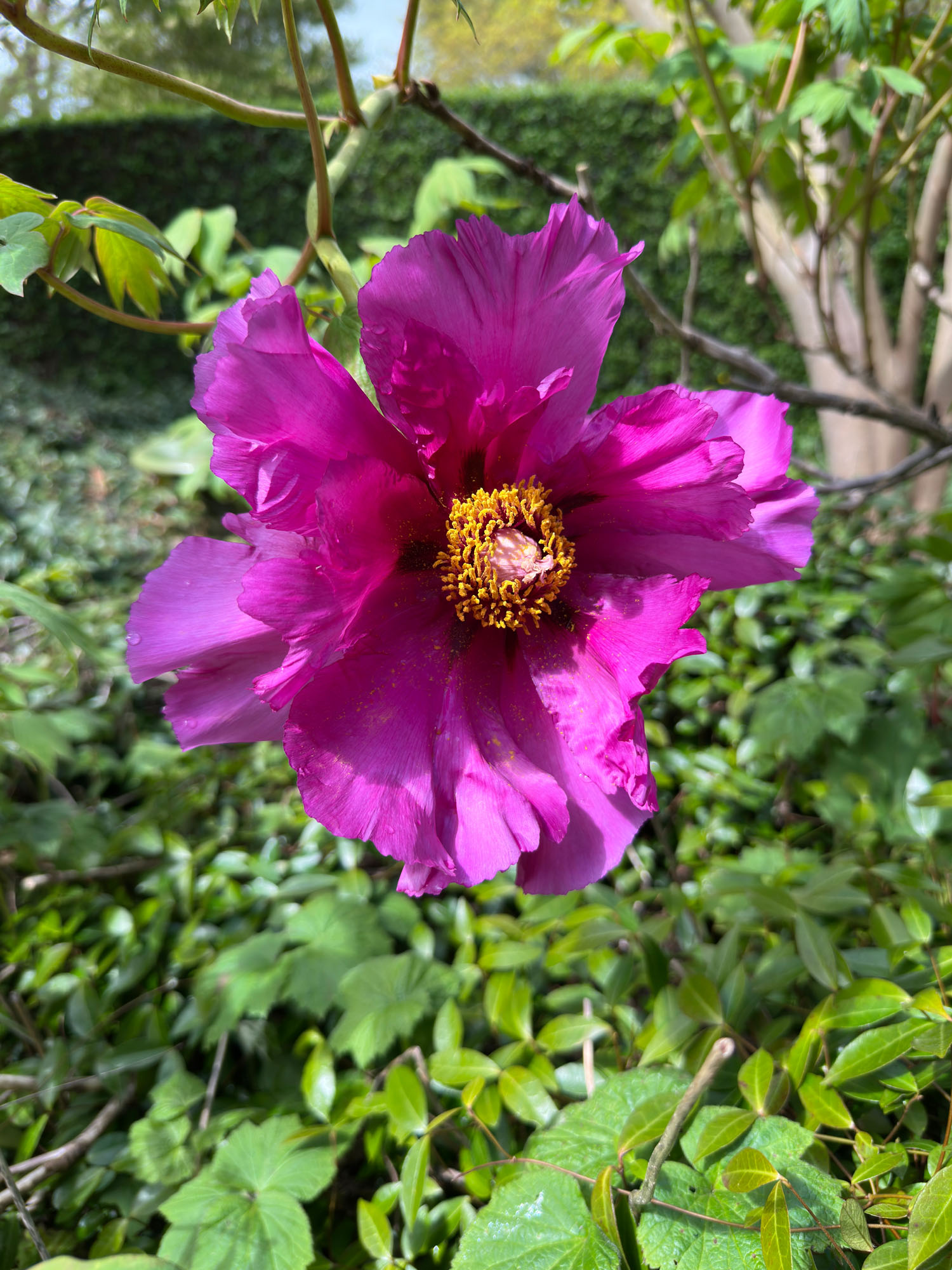
Reg Kinnersley’s peony isn’t the only tree peony that we know was brought into Australia by Chinese gold diggers. Simon Rickard, whose knowledge of tree peonies far surpasses my own, gave me a plant which was originally found growing in a Chinese settlement near Castlemaine in central Victoria. It was taken from there and grown in a Castlemaine garden. If my memory serves me well Simoon told me that the house had been sold recently and a town house development was planned for the site. Simon dug up the peony and gave me half. It has flowered in a sunny spot near our outside dunny for the ten years or so that I’ve had it. For many years, whilst it flowered well, it made hardly any new growth. Happily, this spring a dozen or so new shoots have speared their way through the soil so divisions can soon be made. This clone is very precious not only for its exquisite 15-20cm wide, crimson single flowers, each petal having a pronounced black spot at its base, but also for its historical importance connecting as it does to those brave souls who left family and hearth to travel into what must have been an inhospitable country.
Paeonia suffruticosa, as the Chinese tree peonies are called, is not a species at all but a complex hybrid between five different species of tree peony. The two that I have both flower from late September until mid-October. At Lambley they pass the baton on to a group of hybrids raised in the 1920s by Doctor Saunders, a well-known amateur American peony grower. Saunders crossed two species, Paeonia delavayi and P. ludlowii, with P. suffruticosa giving us vigorous plants with many flowers ranging from soft lemon, peach, coral and blood red. The Saunders hybrids flower during late October and into November. If they have a fault, it is a tendency for the flowers to nod and be slightly concealed by the foliage. The foliage itself is very handsome.
I was given my collection of a dozen or so different Saunders hybrids by the late Dennis Norgate who, for fifty years or so, had Norgate’s Plant Farm between Blackwood and Trentham. Norgate imported these peonies from the USA.
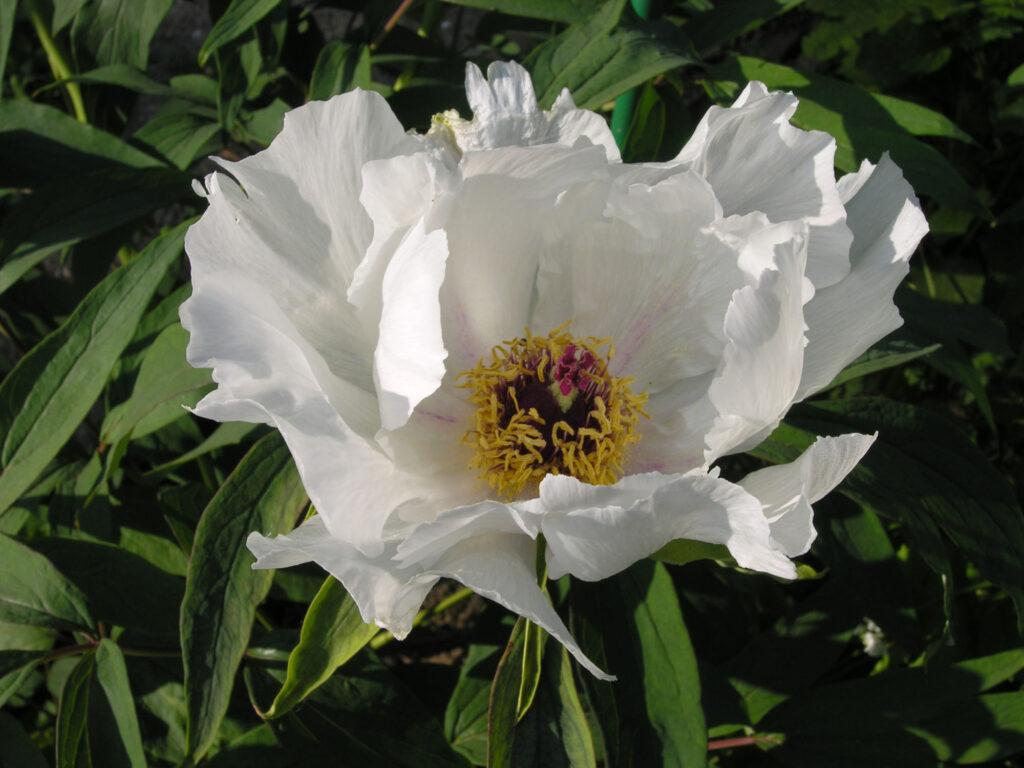
I should also mention that I grow two of the species which were used by Chinese gardeners to breed the P. x suffruticosa hybrids. P. ostii with its exquisite rather raggedly white flowers is the first of all the tribe to flower with me. It is well and truly done by early October. And then there is P. rockii the most handsome of all with its huge white flowers each petal having a black blotch at the base. Sadly, as is the nature of such things, it is the least happy of my collection and rarely graces me with a bloom.
Tree peonies are not hard to grow but are difficult to propagate hence their high price. We grow them in both sun and shade although they seem happier in well nurtured soil in a sunny spot. As long as they are watered a few times during dry periods they are happy. The foliage of the P. x suffruticosa clones tends to burn a little during summer but this has no effect on flowering. The foliage of the Saunders hybrids is beautiful the whole season through and during autumn has quite lovely if rather demur tints of pink and orange.